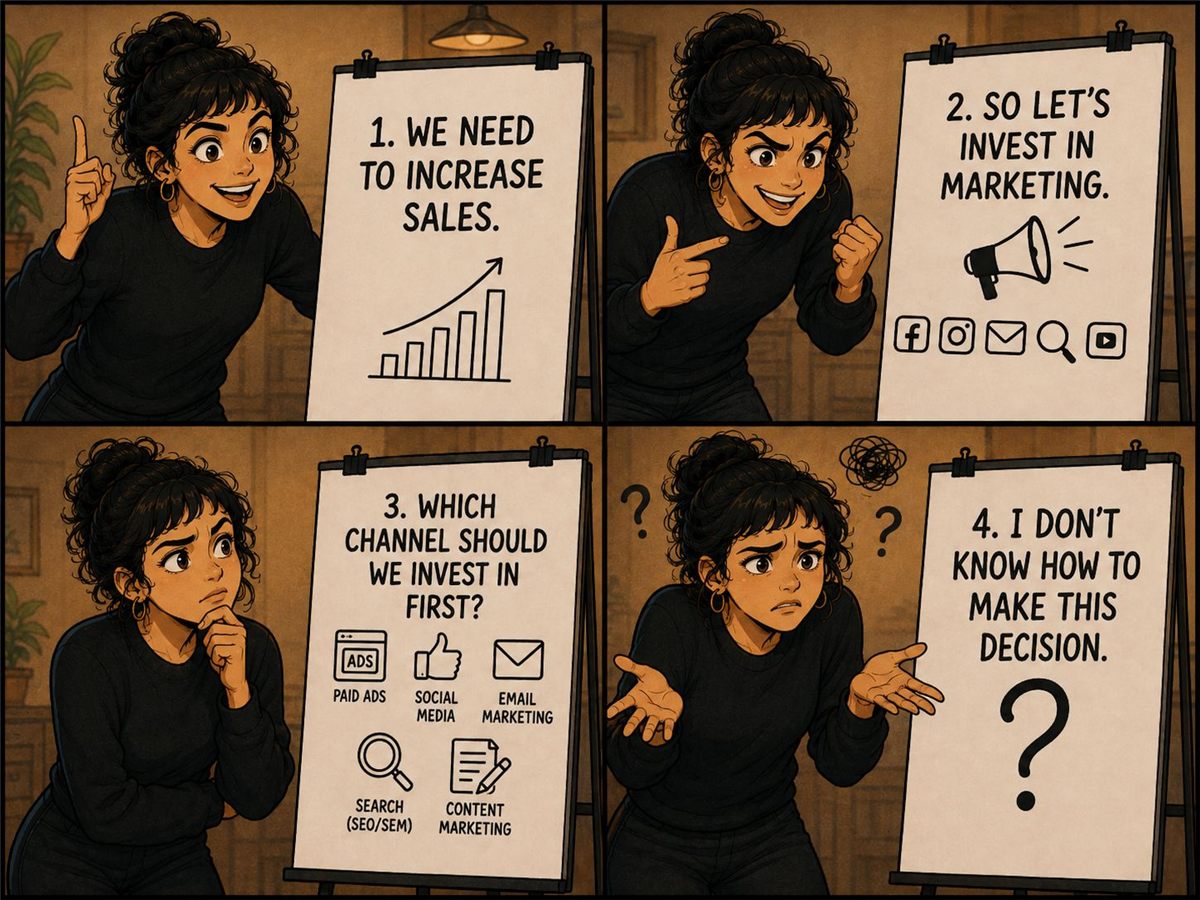
There are settled answers on this, and they cover part of the question. What they don’t do is answer for your company.
What’s already settled
Search reaches people already looking for you. Social reaches people who don’t yet know they need your brand.
Google Ads, GEO and SEO only work if someone types the name of your problem into a search box or a chat. If nobody types it, no budget invents that demand. Meta does the opposite: it puts you in front of people who never thought about the subject. A new business or a little-known category usually starts with social. A category people already search for usually starts with search.
Brand and direct sales pay off on different clocks.
Studies covering hundreds of campaigns show that somewhere between 45% and 60% of the investment needs to go into building the brand, and the rest into immediate conversion. The exact split varies by business. What doesn’t vary: asking a brand investment for the same weekly result you ask of a sales campaign will lead you to switch off the wrong things.
The report inflates what was going to happen anyway.
eBay ran a test in 2014. They switched off their own ads that appeared when someone searched for “eBay” on Google. Revenue barely moved. Those people were already going to buy, and the ad showed up along the way to take the credit.
The same thing happens in your company. Part of what shows up as campaign performance is revenue that would have arrived without it. Finding out how much means switching things off and measuring, not asking for a report.
The channel is the last thing to decide.
Before it come six questions you can already answer about your business, even if you’ve never put the answers in one place.
The six questions
How long between someone hearing about you and paying you?
If it’s four days, you can read a campaign in two weeks. If it’s three months, with a meeting and a proposal in between, what you spent in January only turns into revenue in April. Changing course before that is deciding in the dark.
How much of your price can go into acquiring a customer?
Not the sale price. What’s left after cost, factoring in whether the customer buys once or comes back. Without that number, €150 per new customer and €600 per new customer look equally expensive or equally cheap.
Who closes the sale: the site or a person?
If a salesperson is involved, the channel delivers conversations, not sales. That makes the quality of what arrives matter more than the volume.
Is anyone searching for what you sell?
Real search volume in your category, not your impression of it. If it’s low, search becomes brand defence and you need another engine to grow.
What have you already run, and what did you learn from it?
Almost every company has a history. Few have a reading of it. The data sits there and nobody turns it into a decision.
What can you actually improve in the next ninety days?
This is the question nobody asks, and it decides more than the other five.
Every channel needs a destination. Google Ads and SEO send people to your site. If the site loads slowly, doesn’t explain what you sell or offers no clear path to getting in touch, you’re paying to walk people up to a jammed door. SEO depends on this even more: there is no SEO without someone who can publish, restructure and fix pages on a regular basis. If your site depends on a supplier who disappears for three weeks, that channel isn’t available to you, however much search volume your category has.
Meta plays with different cards. Most of the experience happens inside the platform: the creative, the profile, the DM, the form. The weight shifts off your site and onto your creative. And depending on the campaign, Meta does far more than introduce you to people who don’t know you. It carries them to the sale inside its own environment.
So before choosing: what can you genuinely improve this quarter? Your site, your creative, or neither?
If it’s the site, search becomes a real option. If it’s the creative, social carries more of the load. If it’s neither, the best investment isn’t media. It’s unblocking one of the two first, and that costs less than three months of campaigns pushing people into an experience that doesn’t convert.
This is why “invest in Google” can be right and terrible at the same time. Right for the category, terrible for someone who can’t touch their own website.
The expensive mistake isn’t choosing wrong. It’s choosing without understanding what you’re doing.
The structure behind the choice
You started with the channel. Before it came the strategy, and before the strategy came the structure that holds both up: what you’re going to measure, how often, and who looks at it.
Without that, the right call in January becomes the wrong call by July and nobody notices. The channel keeps running, the invoice keeps arriving, and the last time anyone read it properly was the day the campaign went live.
The fix isn’t another tool. It’s a person with a name who’s responsible for looking:
- Every week: what it cost to acquire a customer per channel, and what changed since last week.
- Every month: that cost against what’s left from each sale, and the quality of what came in, not just the volume.
- Every quarter: a real test. Switch a channel off in one region or for a set period and see what drops.
- Once a year: the six questions again. If any answer changed, the whole allocation goes back on the table.
The calculation nobody runs
A company puts €5,000 a month into marketing. Over twelve months, that’s €60,000.
It made revenue. It has a history. Far from money thrown away.
The problem shows up when planning the next year. Nobody can explain what worked, why, or what would have happened without that channel. So the January decision gets made with exactly the same information as twelve months earlier.
The learning those €60,000 should have bought is still for sale. And it will be charged again next year, and the year after.
The real cost isn’t the amount invested. It’s the number of times you pay for the same information without ever receiving it.
What to do on Monday
Ask three things of whoever runs your marketing, in-house team or agency:
- What it cost to acquire a customer per channel over the last six months, and what’s left from each of those customers.
- Which channel has never been tested by switching it off, and why.
- What we know today that we didn’t know a year ago.
The third one stings. If nobody can answer it, the problem isn’t the channel you picked. It’s treating marketing as a recurring expense instead of a business decision.
Originally published on LinkedIn. Follow me on LinkedIn ↗